
A Guide To The Uberti 1873: History, Rifle & Carbine Review
By Derrick R. Stallings – HuntingOfficer.com
Few firearms carry the legendary weight of the Winchester Model 1873, famously dubbed “The Gun That Won the West.” While finding an affordable, shootable original today is nearly impossible, Italian manufacturer A. Uberti S.p.A. has stepped into the gap. Since 1959, Uberti has built a stellar reputation for crafting some of the world’s most historically accurate, beautifully finished replica firearms.
This comprehensive guide dives deep into the history behind this iconic lever gun, breaks down the mechanical nuances of Uberti’s reproduction, and provides a head-to-head review of the Special Sporting Rifle and the nimble Saddle Ring Carbine configurations.
The History: From Volcanic Roots to Western Legend
To understand why the Uberti 1873 is so special, we have to look back at the evolutionary ladder of 19th-century American firearms engineering:
- The Volcanic Repeater: The mechanism started with an early Smith & Wesson design that utilized a weak, caseless “Rocket Ball” ammunition.
- The Henry Rifle (1860): Oliver Winchester bought the assets, and designer Benjamin Tyler Henry transformed it into a rimfire powerhouse used in the Civil War. However, it lacked a wooden fore-end and was slow to load from the front of the magazine tube.
- The Winchester Model 1866: Known as the “Yellow Boy,” it added a wooden fore-end and Nelson King’s brilliant side-loading gate. It was still limited by its soft brass/bronze frame.
- The Masterpiece of 1873: Winchester upgraded the frame to rugged iron (and later steel), added a sliding dust cover over the ejection port, and chambered it in the legendary .44-40 Winchester Center Fire (.44 WCF).
What truly cemented the 1873’s place in history was ammunition synergy. When Colt began chambering its famous Peacemaker revolver in .44-40, a cowboy, lawman, or settler only needed to carry one size of cartridge on their gun belt to feed both their sidearm and long gun. It wasn’t built to be a sniper rifle—it could barely keep five shots on a dinner plate at 100 yards—but its capacity and rapid-fire reliability made it the ultimate companion for protection and still-hunting.
Inside the Mechanism: How the Uberti 1873 Works
Uberti doesn’t just make guns that look old; they faithfully recreate the exact mechanical layout of the late 19th-century “Third Model” Winchesters. This includes the integral dust cover rail machined directly into the top of the receiver frame.
The Toggle-Link Action
Unlike modern, ultra-strong lever actions (like the Winchester 1892 or Marlin 1895) that use vertical locking blocks, the 1873 relies on a toggle-link system. When you stroke the lever forward, two mechanical links fold down, retracting the bolt and raising a solid brass cartridge lifter. Pulling the lever back snaps the links straight, locking the bolt forward and pushing a fresh round into the chamber.
While this toggle action is not designed for high-pressure modern hot loads or +P ammunition, it is buttery smooth and more than strong enough for traditional cowboy-pressure cartridges.
Safety and Loading Features
- The Lever Safety: A built-in safety block prevents the trigger from being pulled unless the lever is squeezed tight against the stock, ensuring the action is completely closed before firing.
- The Traditional Half-Cock: The hammer features a standard quarter-cock notch that serves as the rifle’s primary safety—meaning no ugly, modern crossbolt buttons to ruin the aesthetic.
- The Loading Gate: Cartridges glide through the spring-loaded gate effortlessly, completely free of the stiff “thumb-pinching” common on later lever-gun designs.
Rifle vs. Carbine: A Head-to-Head Comparison
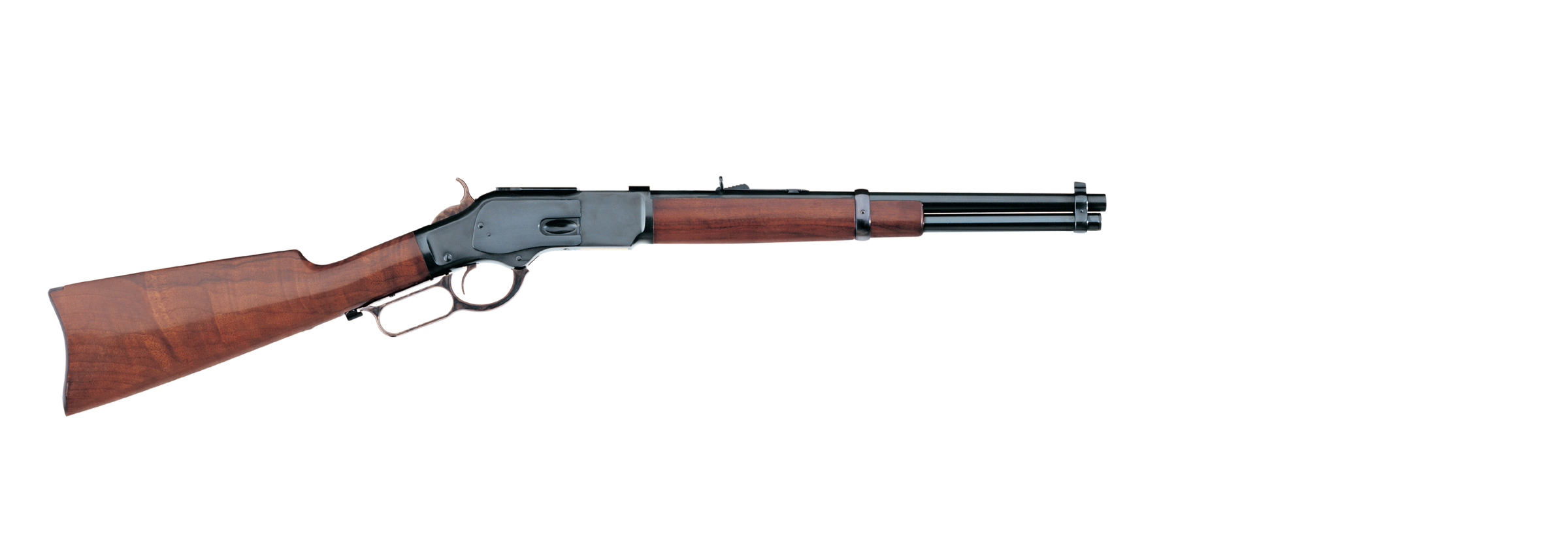
Uberti offers the 1873 in several footprints. The two most prominent choices for shooters are the full-sized Special Sporting Rifle and the utilitarian Saddle Ring Carbine.FeatureUberti 1873 Special Sporting RifleUberti 1873 Saddle Ring CarbineBarrel ProfileFull octagon barrel (typically 24-inch)Round barrel (typically 16 to 20-inch)Average Weight~8.0 lbs to 8.2 lbs~7.0 lbs to 7.4 lbsMagazine CapacityUp to 14 rounds (.45 Colt)10 rounds (.357/.38 Special)Fore-end AttachmentBlued steel nose capTraditional barrel bandButtplate StyleCrescent steel (designed for offhand shooting)Curved carbine-style blued plateSightsAdjustable rear buckhorn, dovetail front postCarbine ladder-style rear, pinned front blade
The Special Sporting Rifle Review
The Uberti 1873 Sporting Rifle is an absolute showstopper. The color case-hardened finish on the receiver, hammer, and lever creates a striking contrast against the deep, mirror-blued finish of the octagonal barrel and magazine tube.
- The Feel: Thanks to its 8-pound weight, shooting low-pressure cartridges feels like shooting a .22 LR. The weight holds incredibly steady for offhand target shooting.
- Capacity and Caliber: In .45 Colt, a 24-inch tube will easily swallow 14 rounds. If you drop down to the shorter .45 Schofield cartridge, you can fit up to 16 rounds, making it incredibly popular for high-volume Cowboy Action Shooting stages.
- Accuracy: With standard round-nose flat-point (RNFP) lead ammunition, it easily punches tight 1.5-to-2-inch groups at 50 yards.
The Saddle Ring Carbine Review
If the rifle is a ballroom dancer, the Carbine is a rugged woodsman. Featuring a shorter 19- or 20-inch round barrel held together by traditional barrel bands, this gun was made to live in a scabbard or slung flat over a hiker’s back.
- The Feel: It is incredibly light, nimble, and fast to swing. The “slab-sided” receiver profile has no protruding bolt handles, ensuring it never snags on thick brush or dense thickets.
- The Saddle Ring: The signature ring on the left side of the receiver was historically used to tie the gun to a rider’s saddle-harness, adding an immediate dose of authentic flair.
- Range Performance: While it lacks the long sight radius of the rifle, it is a de facto “fun gun” that rings steel plates all day with lightning speed.
Handloading & Ammo Tips: Feeding the ’73
If you plan on picking up an Uberti 1873, you need to feed it the right profile of ammunition to prevent a jammed lifter block.
- Bullet Shape Matters: These rifles will not reliably cycle semi-wadcutters (SWC) or sharp, shouldered bullets. Stick strictly to round-nose flat-point bullets with a healthy meplat (like the Lyman No. 452664).
- Go Lead or Go Traditional: While you can shoot jacketed bullets, plain lead cast bullets are more traditional, significantly less expensive, and highly recommended by veteran shooters. Modern manufacturers like Hornady, Black Hills, and HSM offer excellent “Cowboy Action” factory loads.
- The Black Powder Experience: Because the side plates on the 1873 slide right off with a few screws, it is incredibly easy to clean out black powder residue. Shooting real black powder or substitutes like Blackhorn 209 gives you that iconic, cinematic cloud of smoke and that distinct, nostalgic sulfur smell.
One Small Caveat: Watch the Screws
Before heading to the range, there is one critical tip passed down through the collector community: Uberti’s factory screws are notoriously soft. If you use a standard, tapered hardware-store screwdriver to strip the gun down for cleaning, you will gouge or strip the screw heads immediately.
Do yourself an immense favor: invest in a set of hollow-ground gunsmithing screwdrivers. Alternatively, you can buy a hardened aftermarket replacement screw kit from specialized retailers like VTI Gun Parts to replace the factory screws right away.
Final Thoughts: Is the Uberti 1873 Right For You?
The Uberti 1873 isn’t just a replica; it is a time machine. Whether you choose the elegant, long-barreled Special Sporting Rifle for precise target punching, or the quick-handling Saddle Ring Carbine for authentic historical tracking, you are getting an incredibly smooth, addictive firearm. It carries beautifully, cycles like butter, and connects you directly to the heritage of the American frontier.
What about you? Are you leaning toward the classic lines of the octagonal Sporting Rifle, or do you prefer the short, rugged profile of the Carbine? Let me know in the comments below, and don’t forget to share your favorite caliber choice!
Discover more from HuntingOfficer
Subscribe to get the latest posts sent to your email.