
The Lever-Action Rifle: The Most American Firearm Ever Made
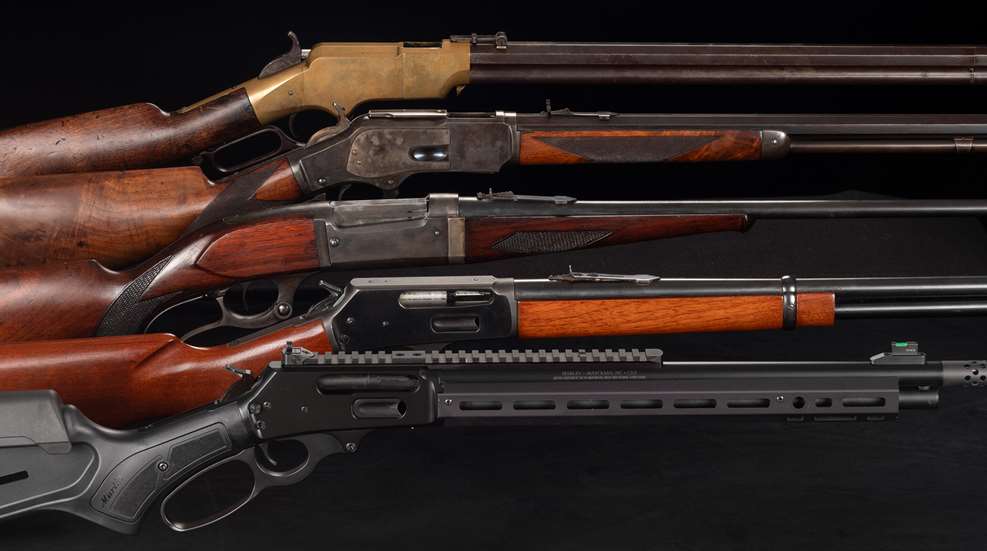
From the frontier to the deer woods, the story of the lever-action rifle is the story of America itself.
By Derrick R. Stallings – HuntingOfficer.com
When people around the world think about American firearms, a few images immediately come to mind. The Colt revolver. The M1911 pistol. The AR-15. But perhaps no firearm is more deeply woven into the American story than the lever-action rifle.
America is known around the world as a nation of gun owners, but only one firearm action has the distinction of being uniquely American: the lever-action.
It wasn’t invented in Europe. It wasn’t refined overseas before making its way to the United States. The lever-action rifle was born from American innovation, developed to meet uniquely American needs, and became one of the defining tools of westward expansion. It helped settle the frontier, feed families, defend ranches, protect stagecoaches, equip lawmen, and even serve soldiers. More than 160 years after its rise to prominence, hunters and shooting enthusiasts still carry lever guns into the woods every fall.
The lever-action isn’t just another rifle. It is a symbol of American ingenuity, independence, and craftsmanship.
Let’s explore the remarkable history behind what many consider America’s rifle.
Before the Lever Gun
In the early 1800s, nearly every firearm was painfully slow by today’s standards.
Most Americans relied on:
- Flintlock muskets
- Percussion cap rifles
- Single-shot muzzleloaders
Loading one shot required a lengthy process:
- Pour powder down the barrel.
- Insert the projectile.
- Ram it into place.
- Prime the ignition system.
- Cock the hammer.
- Fire.
An experienced shooter might fire two or three aimed shots per minute under ideal conditions.
That was acceptable for military formations but far less practical for hunters or settlers facing multiple threats. America was expanding westward, and people needed firearms capable of firing several shots quickly without reloading after every trigger pull.
The race to create repeating firearms had begun.
Walter Hunt and the Beginning of a Revolution
The lever-action story truly begins with inventor Walter Hunt in 1848.
Hunt was one of America’s most prolific inventors. He also designed the modern safety pin, improvements to sewing machines, streetcars, and numerous mechanical devices.
His firearm invention became known as the Volition Repeating Rifle.
While not commercially successful, it introduced revolutionary ideas:
- A lever beneath the receiver
- A tubular magazine
- Multiple shots without reloading
Perhaps its greatest innovation was its unusual ammunition.
Instead of metallic cartridges, Hunt developed what became known as the “Rocket Ball.”
The powder charge was contained inside the hollow base of the bullet itself.
Although ingenious, Rocket Ball ammunition lacked sufficient power and proved unreliable. Even so, Hunt had planted the seed that would eventually grow into one of history’s most famous firearms.
Lewis Jennings Improves the Design
Firearms designer Lewis Jennings acquired Hunt’s concept and made significant improvements.
His rifle retained the lever mechanism but featured a more refined feeding system.
While the Jennings rifle sold in limited numbers, it demonstrated that lever-operated repeaters could be practical.
Even more importantly, the project attracted talented gunsmiths and investors who would continue refining the idea.
Among them was a man named Benjamin Tyler Henry.
Horace Smith and Daniel Wesson Enter the Picture
Yes, those Smith and Wesson.
Before founding the famous revolver company, Horace Smith and Daniel B. Wesson worked extensively on improving repeating rifles.
Building upon Hunt’s ideas, they developed the Smith & Wesson lever-action rifle and eventually founded the Volcanic Repeating Arms Company.
Their Volcanic rifle featured:
- Improved ammunition
- Better reliability
- More refined mechanics
Unfortunately, Volcanic ammunition still lacked sufficient power.
The rifles were innovative but commercially disappointing.
The company struggled financially.
One investor, however, saw tremendous potential.
His name was Oliver Winchester.
Oliver Winchester Changes Firearms History
Oliver Winchester wasn’t originally a gun designer.
He was a successful businessman in the clothing industry who invested in the struggling Volcanic Repeating Arms Company.
Eventually, Winchester gained control of the company.
Instead of abandoning the concept, he hired brilliant engineer Benjamin Tyler Henry.
It would prove to be one of the greatest business decisions in firearms history.
Benjamin Tyler Henry Creates America’s First Great Lever Gun
In 1860, Benjamin Tyler Henry introduced the rifle that changed everything.
The Henry Rifle.
It chambered the revolutionary .44 Henry Rimfire metallic cartridge.
This was a huge leap forward.
For the first time, shooters had:
- Self-contained metallic cartridges
- Reliable ignition
- Faster loading
- Greater durability
- Rapid follow-up shots
The Henry rifle could hold sixteen rounds—an astonishing capacity for the era.
Its lever action allowed shooters to fire much faster than soldiers armed with single-shot muzzleloading muskets.
One Confederate soldier reportedly described it as:
“That damned Yankee rifle that they load on Sunday and shoot all week.”
Whether apocryphal or not, the quote reflects the Henry’s fearsome reputation.
The Civil War
The Henry rifle arrived during the American Civil War.
Although relatively few were officially purchased by the Union Army due to cost, many Union soldiers privately bought Henry rifles with their own money.
In battle, the Henry offered an enormous advantage:
- Higher capacity
- Rapid fire
- Faster reloads
- Reliable operation
Confederate troops quickly learned to respect—and fear—the rifle.
The Henry did not win the Civil War by itself, but it demonstrated that repeating rifles represented the future of warfare.
The Winchester Era Begins
In 1866, Oliver Winchester introduced an improved version of the Henry.
This became the Winchester Model 1866.
Nicknamed the “Yellow Boy” because of its brass receiver, it featured several important improvements:
- Side loading gate
- Closed magazine tube
- Better durability
- Easier reloading
This loading gate remains a defining feature of many lever-action rifles today.
The Winchester name rapidly became synonymous with quality and reliability.
The Rifle That Won the West?
Few firearms are surrounded by as much legend as the Winchester Model 1873.
Often called “The Gun That Won the West,” the nickname actually originated from later Winchester advertising rather than from the frontier era itself. While romanticized, it captured how influential the rifle became in American culture.
The Model 1873 became enormously popular among:
- Cowboys
- Ranchers
- Farmers
- Lawmen
- Outlaws
- Native scouts
- Settlers
One major advantage was its availability in revolver calibers like .44-40 Winchester. A frontiersman could carry a rifle and revolver that used the same ammunition, simplifying life on the frontier.
Famous People Who Carried Lever Guns
The lever-action became associated with many legendary Americans.
Among them were:
- Buffalo Bill Cody
- Theodore Roosevelt
- Annie Oakley
- Tom Horn
- Texas Rangers
- Countless ranchers and settlers
Hollywood later cemented the lever-action’s legendary status, even if movies sometimes sacrificed historical accuracy for dramatic effect.
The Winchester Model 1894
If one lever-action deserves recognition as America’s deer rifle, it is the Winchester Model 1894.
Designed by the legendary John Moses Browning, the Model 1894 introduced stronger steel construction capable of handling smokeless powder cartridges.
It was eventually chambered in the iconic .30-30 Winchester cartridge.
Together, the Model 94 and .30-30 became one of the most successful hunting combinations in history.
More deer have likely been harvested with this pairing than with almost any other rifle and cartridge combination in North America.
Marlin Joins the Competition
While Winchester often receives most of the attention, Marlin became one of America’s premier lever-action manufacturers.
Marlin rifles introduced several improvements:
- Solid-top receivers
- Easier scope mounting
- Side ejection
- Exceptional strength
- Smooth actions
The rivalry between Winchester and Marlin continues today among collectors and hunters.
Ask a lever-gun enthusiast which is better, and you’re likely to start a friendly debate that could last hours.
Lever Guns Beyond the Frontier
By the early 1900s, America had changed dramatically.
The frontier was closing, but lever-actions remained popular.
Hunters appreciated their:
- Fast handling
- Light weight
- Quick follow-up shots
- Reliability
- Compact design
They became especially popular in:
- Thick hardwood forests
- Appalachian mountains
- Southern swamps
- Pacific Northwest timber
- Brush country in Texas
Where long-range shots were uncommon, lever guns excelled.
Why Lever Actions Were Never Standard Military Rifles
Many people wonder why militaries eventually adopted bolt-action rifles instead of lever-actions.
Several factors played a role:
- Tubular magazines limited the use of pointed (spitzer) bullets because bullet tips could rest against the primer of the cartridge ahead, creating safety concerns.
- Bolt actions were generally stronger for increasingly powerful cartridges.
- Bolt-action designs were easier to manufacture consistently for large armies.
- Military doctrine emphasized long-range, massed fire rather than the quick handling prized by hunters.
Even so, lever-actions saw military service in limited roles and were used by militias, law enforcement, and civilians around the world.
Hollywood Makes the Lever Action Immortal
If Winchester built the legend, Hollywood turned it into an icon.
Generations grew up watching Westerns starring:
- John Wayne
- Jimmy Stewart
- Gary Cooper
- Clint Eastwood
- Chuck Connors in The Rifleman
The rapid cycling of the lever became one of cinema’s most recognizable firearm movements.
Many movies took liberties with history—showing models before they actually existed or portraying impossible rates of fire—but they permanently linked the lever-action with the American West.
Modern Lever Actions
Far from becoming obsolete, the lever-action has experienced a resurgence in recent years.
Modern manufacturers continue producing updated versions featuring:
- Stainless steel construction
- Synthetic stocks
- Picatinny rails
- Threaded barrels
- Suppressor compatibility
- Optics-ready receivers
- Improved sights
Companies like Henry Repeating Arms, Winchester, Marlin, Rossi, Chiappa, and others continue introducing new models chambered in both traditional and modern cartridges.
Some even offer lever-actions chambered in handgun cartridges, while others are built for powerful rifle rounds suitable for elk, moose, and bear.
Why Hunters Still Love Lever Guns
Despite advances in semi-automatic rifles and precision bolt actions, lever guns remain incredibly popular.
Reasons include:
- Lightweight designs
- Fast follow-up shots
- Excellent balance
- Natural pointing characteristics
- Compact size for thick woods
- Timeless styling
- Mechanical simplicity
For many hunters, carrying a lever gun is as much about tradition as it is effectiveness.
It connects them to generations of hunters who walked the same woods decades—or even a century—earlier.
Collectors and American History
Original Henry and Winchester rifles have become some of the most sought-after firearms in the collector market.
Rare examples associated with historical figures or military service have sold for hundreds of thousands of dollars, and in exceptional cases, more than a million dollars.
Museums across the United States display these rifles not simply as firearms, but as artifacts that tell the story of westward expansion, industrial innovation, and the growth of the nation.
The Legacy of the Lever Action
The lever-action rifle occupies a unique place in American history because it sits at the intersection of technology, culture, and myth.
It represents:
- American industrial ingenuity
- Westward expansion
- Frontier self-reliance
- Hunting traditions
- Ranching and agriculture
- Competitive shooting
- Family heirlooms passed from one generation to the next
While the “Wild West” often overshadows its broader history, the lever-action’s legacy extends well beyond cowboys and Hollywood. It became the trusted companion of farmers protecting livestock, hunters filling freezers, Native Americans adapting to changing times, lawmen trying to keep order, and ordinary citizens embracing one of the most innovative repeating rifles of the 19th century.
Final Thoughts
Few inventions capture the American spirit like the lever-action rifle. Born from the creativity of inventors such as Walter Hunt and Benjamin Tyler Henry, refined by Oliver Winchester’s business vision, and elevated by John Moses Browning’s engineering genius, the lever-action helped shape a growing nation.
Today, it remains one of the most recognizable firearms ever made—not because it is the fastest or the most powerful, but because it tells a uniquely American story. Whether hanging over a fireplace, displayed in a museum, carried through hardwood forests during deer season, or passed down as a treasured family heirloom, the lever-action continues to bridge generations.
Its enduring appeal is rooted in more than nostalgia. It is a reminder that innovation, craftsmanship, and practical design can leave a lasting mark on history. More than 175 years after the first concepts emerged, the unmistakable motion of working a lever still evokes images of independence, resilience, and the frontier spirit that helped define the United States.
For many Americans, the lever-action rifle isn’t just part of firearms history—it is part of the nation’s identity.
*AI was used in part to create this post.
Discover more from HuntingOfficer
Subscribe to get the latest posts sent to your email.